In this case, the client downloaded, in Excel format, six statements for different bank accounts from the websites of their two banks. They had to enter them in blocks into their ERP, carry out a bank reconciliation and finally transfer those movements to another Excel file they used to analyse the companies' cash position.
The internal reconciliation work inside the ERP will be a phase II of the automation. Nevertheless, the data handling, where the work was simple but slow, was carried out successfully.
The result: 30 minutes saved each week and a product that needs only one click to start and process all the data.
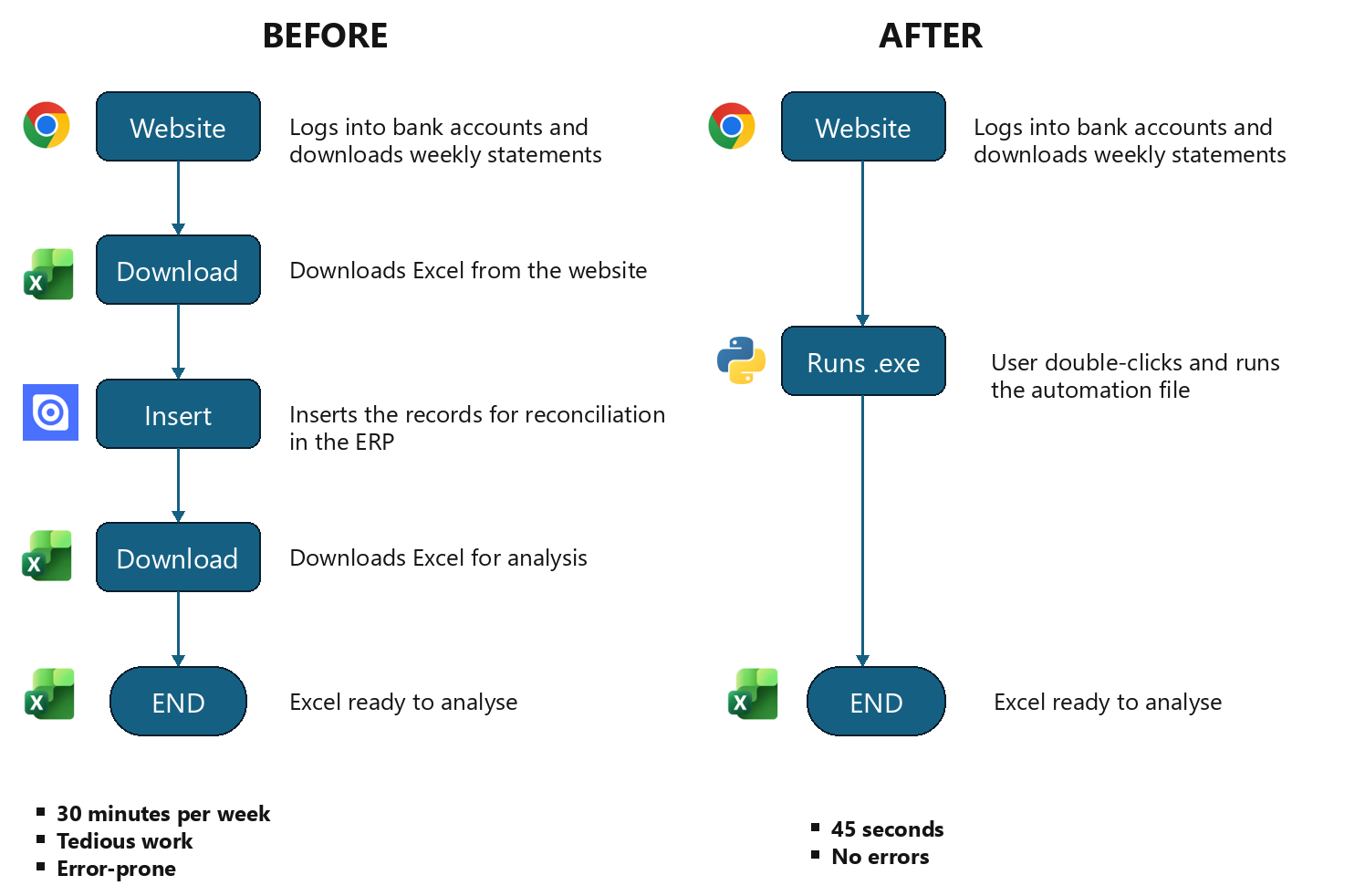
No recurring cost, no future errors, one more solution that helps make the company's processes more efficient. In the new era of AI, people should add value in workflows that truly require it, not in places where a process run with Python works better and faster.
Our next step will be to access the bank accounts via API. We will do it as a self-running process in Windows scheduled tasks, one day a week. That will spare us the tedium of logging into the banks and downloading the statements. The 45 seconds will drop to 0.
The curious thing, and I leave it as a personal reflection, is that AI was not needed to do all of the above. This process could have been successfully implemented in the company many years ago. The advantage AI brings is precisely the cost: where more than 1,000 euros would have been paid before, this automation cost no more than 300.